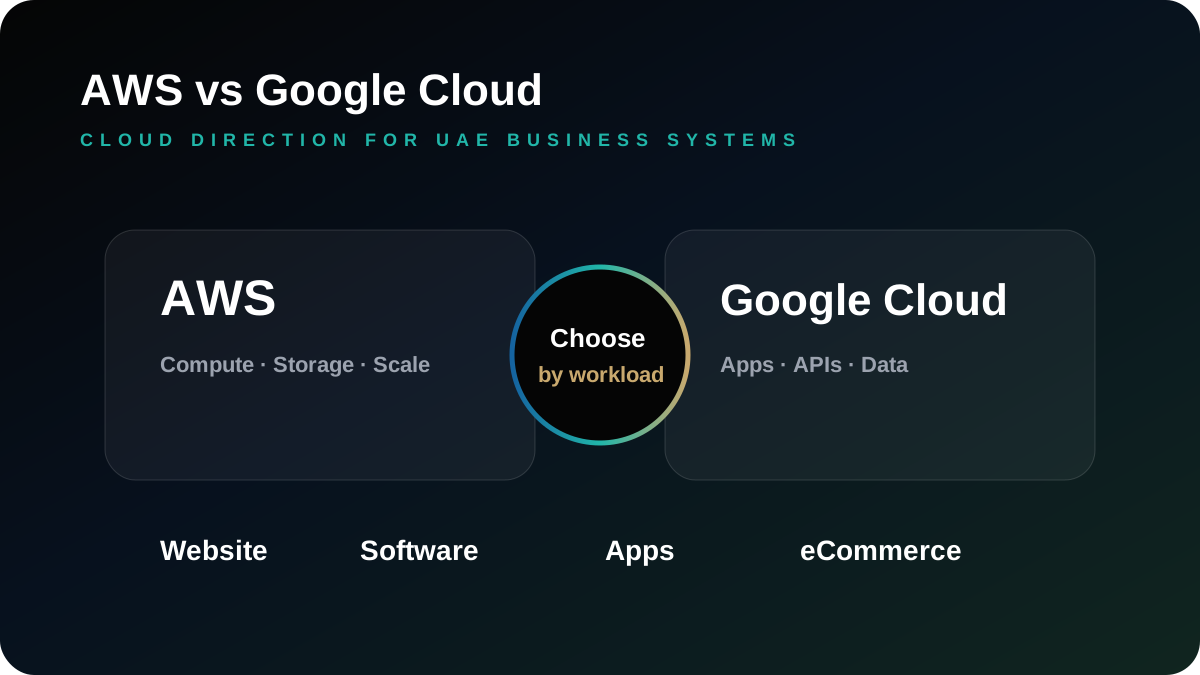
AWS and Google Cloud can both support serious business websites, custom applications, APIs, databases, storage, backups, and mobile app backends. The right choice depends less on brand preference and more on workload, team experience, budget, integrations, support model, and long-term roadmap. For most UAE businesses, the best decision starts with the system requirements, not the provider logo.
A cloud provider alone does not guarantee speed, uptime, or security. The architecture, deployment process, access control, monitoring, backup routine, and support responsibility matter just as much. A poorly planned cloud setup can become more confusing and more expensive than a simple managed hosting environment.
When AWS may be a good fit
AWS may be useful when a company wants a broad cloud ecosystem, flexible infrastructure options, application hosting, object storage, database planning, monitoring, backup routines, and mature deployment possibilities. It can be a strong direction for custom software, eCommerce platforms, portals, APIs, and mobile app backends when the project needs control and future scalability.
When Google Cloud may be a good fit
Google Cloud may be useful for application deployment, APIs, storage, databases, analytics-connected workflows, and teams that prefer the Google Cloud ecosystem. It can support business websites, applications, customer portals, reporting dashboards, and mobile app backends when the architecture is planned around real usage and support needs.
Where both platforms are similar
Both platforms can support compute, storage, databases, networking, monitoring, logging, security controls, backup planning, and scalable deployments. From a business perspective, the biggest difference is often not the capability of the platform but who will design it, document it, maintain it, monitor it, and respond when something needs attention.
Questions to ask before choosing
Ask what will be hosted, how much traffic is expected, how critical uptime is, what data must be stored, how often backups should run, who manages updates, how code is deployed, what monitoring is required, what integrations are planned, and what budget range is realistic. These answers usually matter more than broad comparisons between cloud brands.
Do all websites need AWS or Google Cloud?
No. A small brochure website or landing page may work well on reliable managed hosting. Cloud hosting becomes more relevant when the website is tied to revenue, applications, APIs, customer data, booking workflows, payment gateways, or internal business operations. A good technical partner should recommend the appropriate level of infrastructure, not automatically push every business into a complex setup.
SEO and performance considerations
Cloud hosting can support better performance, but SEO also depends on front-end code, image optimization, server response, caching, URL structure, content quality, redirects, schema, and mobile UX. A fast cloud server cannot fix a heavy or poorly built website by itself. Infrastructure and website development should be reviewed together.
Security and support considerations
Both AWS and Google Cloud require sensible access management, SSL, backup routines, monitoring, update discipline, and clear ownership. Businesses should avoid shared credentials and unclear vendor access. The support process should define who handles downtime, deployment problems, database issues, SSL renewal, DNS changes, and emergency restore requests.
Gligx recommendation approach
Gligx reviews the project first, then recommends whether AWS cloud hosting services, Google Cloud services, managed hosting, or another infrastructure direction is suitable. The goal is to choose a platform that supports the website, software, app, SEO, security, and business continuity requirements without unnecessary complexity.
Practical decision summary
Choose AWS or Google Cloud only after the business knows what it needs to run, how it will be maintained, and how it will grow. For UAE companies, the best cloud direction is usually the one that gives the right balance of reliability, cost, support, security, and room for future development.
Do not choose cloud infrastructure by trend
Some companies choose AWS or Google Cloud because they sound modern. That is not enough. The better question is whether the business has a workload that needs cloud infrastructure and whether the team has a support process to manage it. A simple website with low traffic may not need the same architecture as a custom portal or mobile app backend.
Where a technical review helps
A technical review should look at application stack, CMS, database size, media files, expected traffic, payment flows, APIs, backup requirements, security expectations, and future roadmap. After that, it becomes easier to decide whether AWS, Google Cloud, managed hosting, or a hybrid approach is more practical.
How this affects long-term SEO and growth
Cloud infrastructure can support reliability and performance, but organic growth still needs good content, technical SEO, internal linking, mobile UX, schema, and conversion tracking. Infrastructure should support SEO and marketing, not replace them. This is why cloud planning should connect with SEO services, website design, and analytics setup.
What decision-makers should ask internally
Before choosing AWS or Google Cloud, ask who will own the account, who will approve access, who will review bills, who will check backups, who will deploy updates, and who will respond if the system is down. These questions are not as exciting as platform features, but they decide whether the cloud setup is manageable.
Also ask whether the current website or application is already optimized. If code, images, database queries, or scripts are inefficient, moving to cloud may hide the problem temporarily instead of solving it.
Gligx cloud recommendation style
Gligx does not recommend a cloud platform only because it is popular. We review the business requirement first, then suggest an infrastructure path that fits the project. For some websites that is managed hosting. For larger web applications, APIs, eCommerce systems, or mobile backends, AWS or Google Cloud may be the stronger direction.
Frequently Asked Questions
Is AWS better than Google Cloud?
Neither is automatically better. The right choice depends on the workload, integrations, budget, support model, and team preference.
Can Gligx advise between AWS and Google Cloud?
Yes. Gligx can review the website, app, software, database, traffic, integrations, and support expectations before recommending a direction.
Do small company websites need cloud hosting?
Not always. Many small websites work well on reliable managed hosting. Cloud hosting is more useful for business-critical systems, custom apps, APIs, or scaling requirements.
Does cloud hosting improve page speed?
It can help, but page speed also depends on front-end code, images, caching, scripts, database queries, and server configuration.